
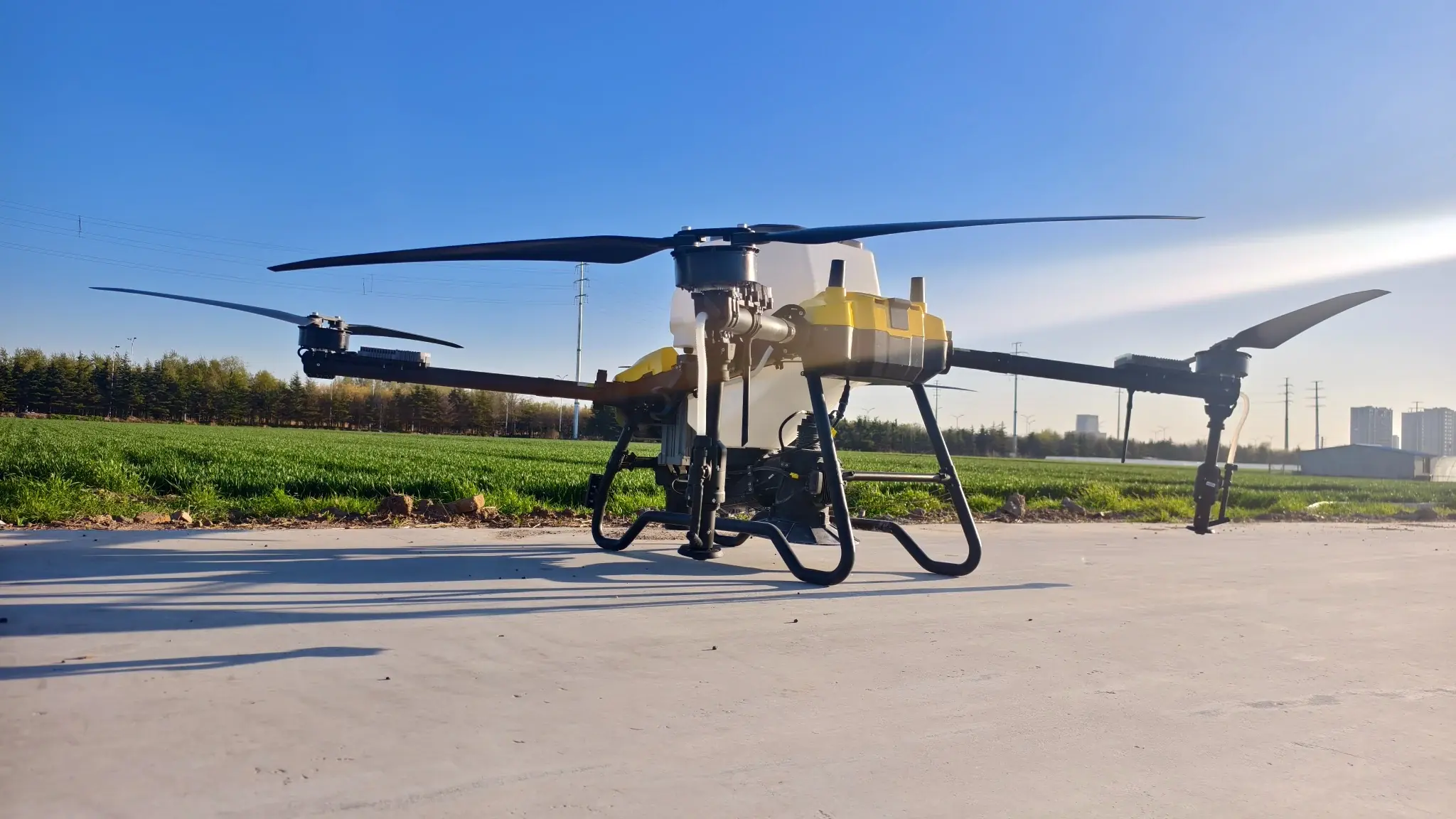
How to Choose an Agricultural Spraying Drone: A Buyer’s Guide
Choosing the right agricultural spraying drone is an important investment for farmers, agricultural contractors, and professional crop protection service providers.
With different tank capacities, spraying systems, flight technologies, and battery configurations available, selecting the right model requires more than simply comparing specifications.
The best agricultural spraying drone should match your crop types, farm size, application requirements, operating conditions, and long-term budget.
In this guide, JOYANCE TECH explains six important factors to consider before purchasing an agricultural spraying drone, helping you identify the right equipment for your farming operations.
1. Choose the Right Tank Capacity for Your Farm Size
Tank capacity is one of the first specifications buyers should compare when selecting an agricultural spraying drone.
A larger tank carries more spraying liquid per flight, potentially reducing refill frequency and improving operational efficiency. However, tank capacity should be considered alongside aircraft weight, battery consumption, transportation requirements, and field conditions.
JOYANCE TECH offers several agricultural spraying drone configurations to accommodate different operational needs:
| Model | Spraying Tank Capacity |
|---|---|
| JT20 | 20L |
| JT20HY Hybrid | 20L |
| JT30 | 30L |
| JT40 | 40L |
| JT50 | 50L |
| JT100 | 70L |
How Much Area Can One Tank Cover?
The spraying area per tank depends on the application rate, usually measured in liters per hectare (L/ha).
For example, at an illustrative application rate of 15 L/ha:
- A 20L tank covers approximately 1.33 hectares.
- A 30L tank covers approximately 2 hectares.
- A 40L tank covers approximately 2.67 hectares.
- A 50L tank covers approximately 3.33 hectares.
- A 70L tank covers approximately 4.67 hectares.
These are theoretical estimates. Actual coverage depends on crop requirements, application rates, operating conditions, and usable tank volume.
Which Capacity Should You Choose?
- 20L models: Suitable for smaller farms, fragmented fields, and operators prioritizing compact equipment.
- 30L models: Offer a balance between payload capacity and operational flexibility.
- 40L models: Suitable for medium-to-large agricultural operations requiring greater spraying capacity.
- 50L models: Designed for larger workloads and professional agricultural service providers.
- 70L models: Suitable for demanding large-scale operations where greater liquid capacity per flight is important.
The right choice depends on your actual field conditions and daily spraying requirements, rather than tank capacity alone.
2. Compare the Spraying Systems Before Buying
The spraying system directly affects droplet characteristics, spray width, and application performance.
Two common technologies are conventional pressure nozzles and centrifugal nozzles.
Conventional Pressure Nozzles
Conventional pressure nozzles use water pump pressure to atomize the spraying solution.
They offer a relatively simple structure, straightforward maintenance, and lower replacement costs. They are commonly used for field crops such as rice, wheat, corn, and vegetables.
Centrifugal Nozzles
Centrifugal nozzles use a motor-driven rotating disc to atomize liquid through centrifugal force.
Compared with conventional pressure nozzles, they provide adjustable droplet characteristics and a wider reference spraying width.
According to JOYANCE TECH’s nozzle specifications:
- Conventional pressure nozzle droplet size: approximately 100–200 μm.
- Centrifugal nozzle droplet size: adjustable from 50–500 μm.
- Reference single-nozzle spraying width: 0.5–1 m for conventional nozzles and 3–4 m for centrifugal nozzles.
Centrifugal nozzles are particularly worth considering for operators working with fruit trees, vineyards, coffee plantations, and other crops with different canopy structures.
JOYANCE TECH centrifugal nozzle technology is available across its agricultural drone range, providing additional flexibility when selecting a spraying configuration.
For a detailed comparison of nozzle structures, adjustable droplet size, flexible rubber tubing, and anti-drip design, read our dedicated guide: Centrifugal Nozzle Technology for Agricultural Spraying Drones.
3. Consider Flight Control, Navigation, and Obstacle Avoidance
Flight control and navigation technologies influence how easily an agricultural spraying drone can operate in different farming environments.
Before purchasing, consider the following features:
Autonomous Flight Planning
An autonomous flight planning system allows operators to define field boundaries and create flight routes through a compatible control application.
Depending on the system configuration, useful functions may include:
- Automatic route generation.
- Automated spraying along planned routes.
- Route resumption after interruptions.
- Automatic return-to-home functionality.
These features can help reduce repetitive manual control and support more consistent field operations.
RTK Positioning
RTK positioning technology provides high-precision positioning for agricultural drone operations.
It can help improve flight path consistency and support more accurate route planning, particularly when working across larger or repeatedly treated fields.
When comparing models, check the actual RTK configuration, positioning specifications, and compatibility requirements.
Radar and Terrain Following
Agricultural fields are not always flat or free of obstacles.
Terrain-following radar can help maintain a more consistent flight height over changing ground or crop surfaces.
Obstacle detection systems can help identify potential obstacles such as trees and other objects, depending on their detection direction and operating conditions.
If you frequently work in orchards, hilly terrain, or fields with obstacles, these technologies should be important considerations when choosing your equipment.
4. Evaluate Battery Performance and Charging Efficiency
Battery performance directly affects daily operating schedules and the number of flights an agricultural drone can complete.
For professional agricultural operations, purchasing a drone is not just about the aircraft itself. The battery and charging system are equally important.
Consider the following factors:
- Battery capacity: Check whether the battery configuration matches the aircraft’s payload and operating requirements.
- Charging power: Higher charging power can help reduce charging intervals when supported by the battery system.
- Cooling system: Battery and charger cooling arrangements are important during repeated charging cycles.
- Battery rotation: Having multiple batteries available allows operators to alternate between charging and field operations.
For operators working long hours, a properly configured battery and charging system can help reduce downtime and improve equipment utilization.
When comparing agricultural spraying drones, evaluate the complete battery package rather than looking at flight time alone.
5. Check Durability, Materials, and Maintenance Requirements
Agricultural spraying drones operate in environments involving water, fertilizers, pesticides, dust, vibration, and frequent transportation.
Long-term reliability should therefore be an important part of your purchasing decision.
Consider these areas:
Aircraft Frame and Structure
A robust frame and properly designed folding structure can support transportation and repeated field operations.
Check the materials used in the aircraft frame, arm connections, landing gear, and other structural components.
Waterproofing and Corrosion Resistance
Spraying equipment is regularly exposed to agricultural chemicals and liquid residues.
Check the actual waterproof rating of the model you intend to purchase, as different models may have different protection levels.
Also consider the corrosion resistance of pumps, connectors, wiring, and other components exposed to spraying liquids.
Maintenance and Spare Parts
Before purchasing, ask the manufacturer about:
- Availability of replacement components.
- Pump and nozzle maintenance.
- Motor and ESC servicing.
- Battery replacement.
- Technical documentation and troubleshooting support.
A suitable agricultural drone should not only perform well when new but also remain practical to maintain throughout its service life.
6. Select the Right Agricultural Drone Manufacturer and Support Partner
The manufacturer you choose can be just as important as the drone itself.
For international buyers, especially agricultural distributors and crop protection service providers, reliable technical support and spare parts availability are essential considerations.
Before placing an order, evaluate:
- Manufacturing experience: Does the company have established experience in agricultural drone development and production?
- Product range: Can the manufacturer offer different tank capacities for different customer requirements?
- Customization: Are OEM and ODM solutions available when required?
- Technical support: Can the manufacturer provide operating instructions, troubleshooting assistance, and technical documentation?
- After-sales service: Is there a clear process for spare parts supply and maintenance support?
- Export experience: Does the company have experience supplying agricultural equipment to international markets?
Working directly with an experienced manufacturer can make product selection, configuration, and long-term equipment support easier.
7. Which JOYANCE TECH Agricultural Spraying Drone Is Right for You?
JOYANCE TECH offers six agricultural drone models with different spraying capacities and configurations.
The JT series is designed to accommodate different farm sizes, crop protection requirements, and agricultural operating conditions.
| Model | Spraying Capacity | General Positioning |
|---|---|---|
| JT20 | 20L | Compact agricultural operations |
| JT20HY Hybrid | 20L | Hybrid-powered spraying operations |
| JT30 | 30L | Flexible medium-capacity operations |
| JT40 | 40L | Medium-to-large agricultural operations |
| JT50 | 50L | Professional large-scale operations |
| JT100 | 70L | High-capacity agricultural operations |
Some models also support dry-material spreading configurations, allowing operators to carry out additional agricultural applications such as fertilizer and seed spreading. Check individual product specifications for the corresponding spreading capacity and configuration.
Explore the JOYANCE TECH Agricultural Drone Range
Choose a model according to your spraying requirements, field conditions, and preferred equipment configuration.
- JT20 Agricultural Drone: A compact 20L spraying solution.
- JT20HY Hybrid Agricultural Drone: A hybrid-powered 20L spraying solution.
- JT30 Agricultural Drone: A 30L configuration for flexible agricultural operations.
- JT40 Agricultural Drone: A 40L spraying platform with additional spreading capability.
- JT50 Agricultural Drone: A higher-capacity platform for professional operations.
- JT100 Agricultural Drone: A high-capacity platform for demanding agricultural applications.
Visit our Agricultural Spraying and Spreading Drones page to compare the complete product range and explore individual model specifications.
Conclusion: Make the Right Investment in Agricultural Spraying Equipment
Choosing an agricultural spraying drone requires a comprehensive evaluation of tank capacity, spraying technology, flight control, battery performance, durability, and manufacturer support.
A compact model may be more practical for smaller farms and fragmented fields, while larger-capacity drones can help reduce refill frequency in demanding agricultural operations.
The best choice is the model that matches your actual working conditions and provides a suitable balance between operating efficiency, equipment investment, and long-term maintenance.
JOYANCE TECH provides a range of agricultural spraying drones from 20L to 70L spraying capacity, with different configurations to support modern crop protection and precision farming.
Looking for the right agricultural spraying drone for your business?
Contact JOYANCE TECH to discuss your crop types, farm size, spraying requirements, and preferred equipment configuration.